


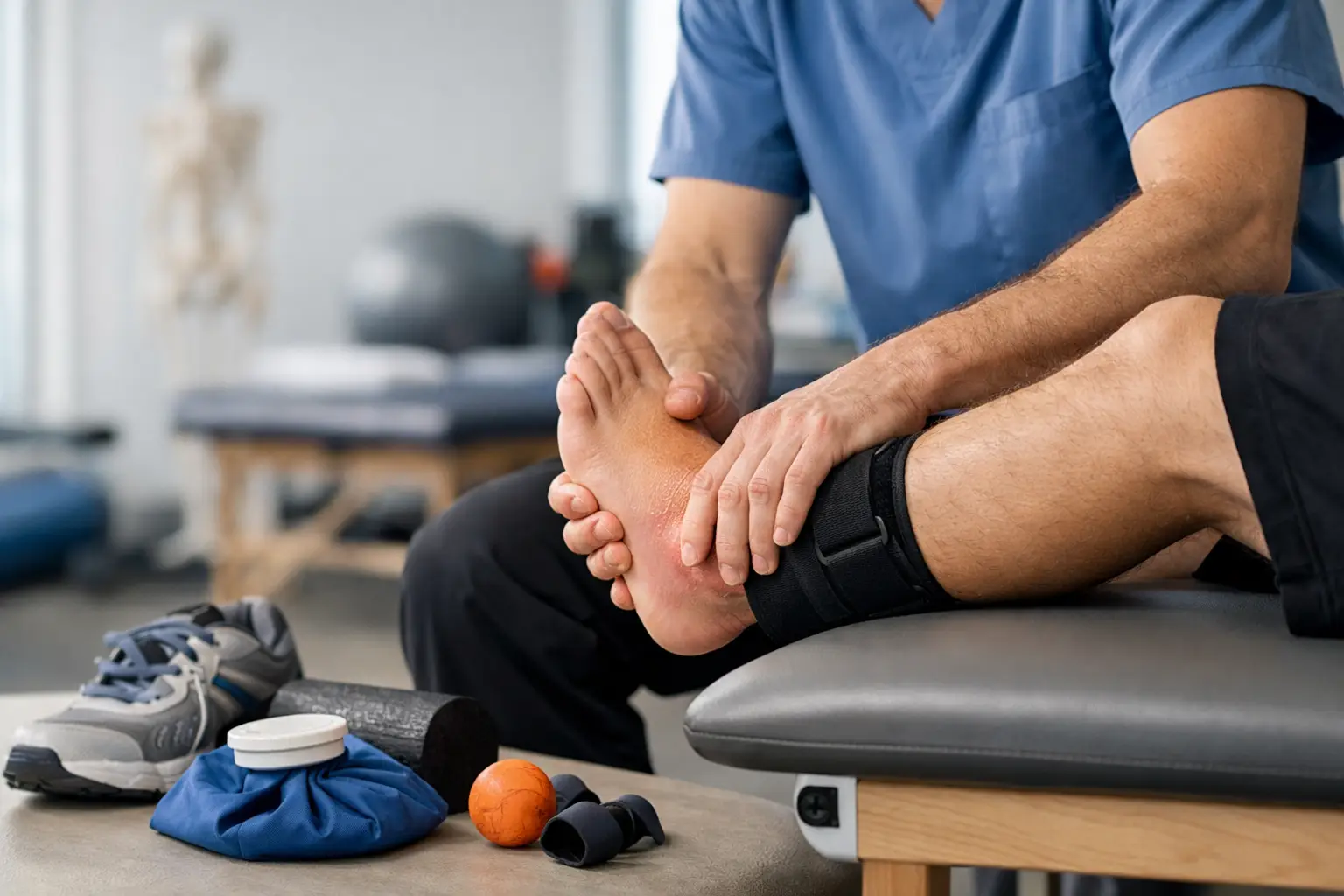
Ankle Pain Rehabilitation Guide for Safer Recovery
A swollen ankle after a misstep on the pavement can look similar to an ankle that has been painful for months without a clear injury. The rehabilitation needed may be very different. This ankle pain rehabilitation guide explains how recovery should be structured around an accurate diagnosis, realistic loading and clear markers of progress rather than a generic set of exercises.
Ankle pain can arise from a ligament sprain, tendon irritation, joint stiffness, arthritis, a stress injury, instability or pain referred from elsewhere in the lower limb. The right treatment plan starts by establishing which tissues are involved and what is keeping symptoms active.
Start with assessment, not assumptions
It is tempting to treat every painful ankle as a sprain. However, pain on the outside of the ankle after a twist is managed differently from pain behind the ankle, beneath the inner ankle bone or deep within the joint. The location, timing and behaviour of pain all matter.
A structured clinical assessment considers how the pain began, whether there was swelling or bruising, which movements provoke symptoms, and how the ankle performs during walking, stairs, work and sport. Your clinician should also assess joint range, strength, balance, footwear, foot posture and the way force travels through the leg.
Diagnostic ultrasound may be clinically appropriate where a tendon, ligament or soft-tissue problem is suspected. It can help clarify whether a tendon is thickened or irritated, whether fluid is present, or whether a ligament injury needs a more cautious rehabilitation pathway. Ultrasound is not required for every ankle problem, but when used at the right point it can make treatment planning more precise.
Know when ankle pain needs urgent review
Rehabilitation is not a substitute for urgent medical assessment. Seek prompt advice if you cannot take four steps after an injury, the ankle looks deformed, pain is severe or rapidly worsening, or there is marked swelling and bruising over bone. A suspected fracture may need X-ray assessment.
You should also arrange urgent review if the calf becomes swollen, hot or tender, if the foot is cold, pale or numb, or if you develop fever, spreading redness or a wound. Persistent night pain, unexplained swelling, or pain that is not improving despite reducing activity should also be assessed rather than repeatedly exercised through.
The ankle pain rehabilitation guide: use stages, not dates
Recovery is better guided by what your ankle can tolerate than by a fixed timetable. A mild sprain may settle relatively quickly, while tendon pain, repeated instability or joint irritation can take longer. Returning to running because a calendar says you should, rather than because the ankle is ready, is a common reason for setbacks.
Stage 1: Settle symptoms while keeping moving
In the early phase, the aim is to reduce unnecessary irritation without making the ankle stiff or weak. Relative rest is usually more useful than complete rest. This may mean replacing running, football or long walks with activities that do not significantly increase pain during or after exercise.
Supportive footwear and, where appropriate, a brace or taping can reduce strain during walking. Compression and elevation may help manage swelling after an acute injury. Cold therapy can provide short-term pain relief for some people, but it does not repair the underlying issue.
Gentle ankle movement is often introduced early if fracture and serious injury have been excluded. Controlled pointing and lifting of the foot, slow ankle circles and comfortable weight transfer can prevent stiffness. Exercise should not cause sharp pain, a significant limp or a lasting increase in swelling.
Stage 2: Restore movement and normal walking
Once acute pain and swelling are improving, focus shifts to restoring movement needed for everyday life. Limited ankle bend, particularly when the knee travels forwards over the toes, can affect stair climbing, squatting and walking speed. It can also place extra demand on the foot, knee and Achilles tendon.
Exercises may include knee-to-wall ankle movements, calf stretching where appropriate, and controlled heel raises. The exact selection depends on the diagnosis. For example, aggressive stretching may aggravate some tendon conditions, while a stiff ankle after immobilisation may need a stronger emphasis on mobility.
A useful early goal is to walk with an even stride, without protecting the painful side. If you are still limping, walking long distances or returning to impact exercise usually adds load before the ankle has regained enough capacity.
Stage 3: Rebuild strength and control
Ankle rehabilitation is not only about making the pain disappear. The surrounding muscles must regain their ability to control the foot and absorb force. Calf weakness, reduced side-to-side control and poor balance can all contribute to recurrent symptoms.
A programme may progress from supported double-leg heel raises to single-leg heel raises, resistance-band movements and slow controlled lowering exercises. Balance work might begin with standing on one leg near a support, then progress to reaching movements, uneven surfaces or sport-specific challenges.
Quality matters more than simply completing repetitions. A heel raise performed with the ankle rolling outwards, a painful pinch at the front of the joint, or a knee collapsing inwards may show that the exercise needs modifying. Mild effort and manageable discomfort can be acceptable in some rehabilitation plans, particularly for tendon conditions, but pain should settle predictably afterwards rather than building day by day.
Stage 4: Return to impact, work and sport
Before returning to running or cutting movements, the ankle should cope with brisk walking, stairs, repeated heel raises and single-leg balance without a meaningful symptom flare. For runners, a gradual walk-run plan is usually safer than restarting at a previous distance or pace.
Sport adds demands that simple gym exercises do not always reproduce. Hopping, landing, changing direction and decelerating need to be introduced progressively. Someone returning to a desk-based role may need only comfortable walking and stair use, whereas a footballer, dancer or tradesperson may need much higher levels of ankle strength, mobility and confidence.
The 24-hour response is a practical way to judge loading. If symptoms are substantially worse later that day or the following morning, reduce the volume, speed or impact level of the previous session. If symptoms remain stable and function improves, progression is more likely to be appropriate.
Address the reason pain keeps returning
Recurring ankle pain is often not caused by one missed exercise. It may reflect incomplete recovery, repeated overload, poor ankle mobility, chronic instability, unsuitable footwear, or a training increase that outpaced the tissue’s capacity. Some people continue to roll the ankle because the ligaments and balance system have not regained sufficient control. Others develop persistent tendon symptoms because pain was ignored while running volume increased.
Footwear can be relevant, but there is no single best shoe for every painful ankle. A stable, well-fitting shoe may help in some cases, while a change in heel height or shoe stiffness can aggravate others. Custom orthotics may be considered when foot mechanics are contributing to overload, but they should support a wider rehabilitation plan rather than replace strength and movement work.
Where symptoms persist, treatment may include targeted manual therapy, rehabilitation-led follow-up, temporary offloading, or clinically justified procedures. These decisions should follow diagnosis. An injection, for example, may be appropriate for selected conditions but is not a universal answer to ankle pain and should be paired with a clear plan for what happens afterwards.
When to book a specialist ankle assessment
Arrange assessment if ankle pain has not improved after a short period of sensible activity modification, if it repeatedly returns when you resume exercise, or if you are unsure what structure is causing it. This is particularly worthwhile after a significant twist, when the ankle feels unstable, when pain is localised to a tendon, or when swelling persists.
At South London Foot Clinic, assessment is designed to establish the cause of pain before treatment is selected. Where indicated, ultrasound can be incorporated into the clinical pathway so that findings are discussed alongside your examination and functional goals.
A good rehabilitation plan should leave you knowing what is being treated, what you can safely do this week, what progress should look like and when the plan needs reviewing. That clarity is often the first step towards trusting the ankle again.