


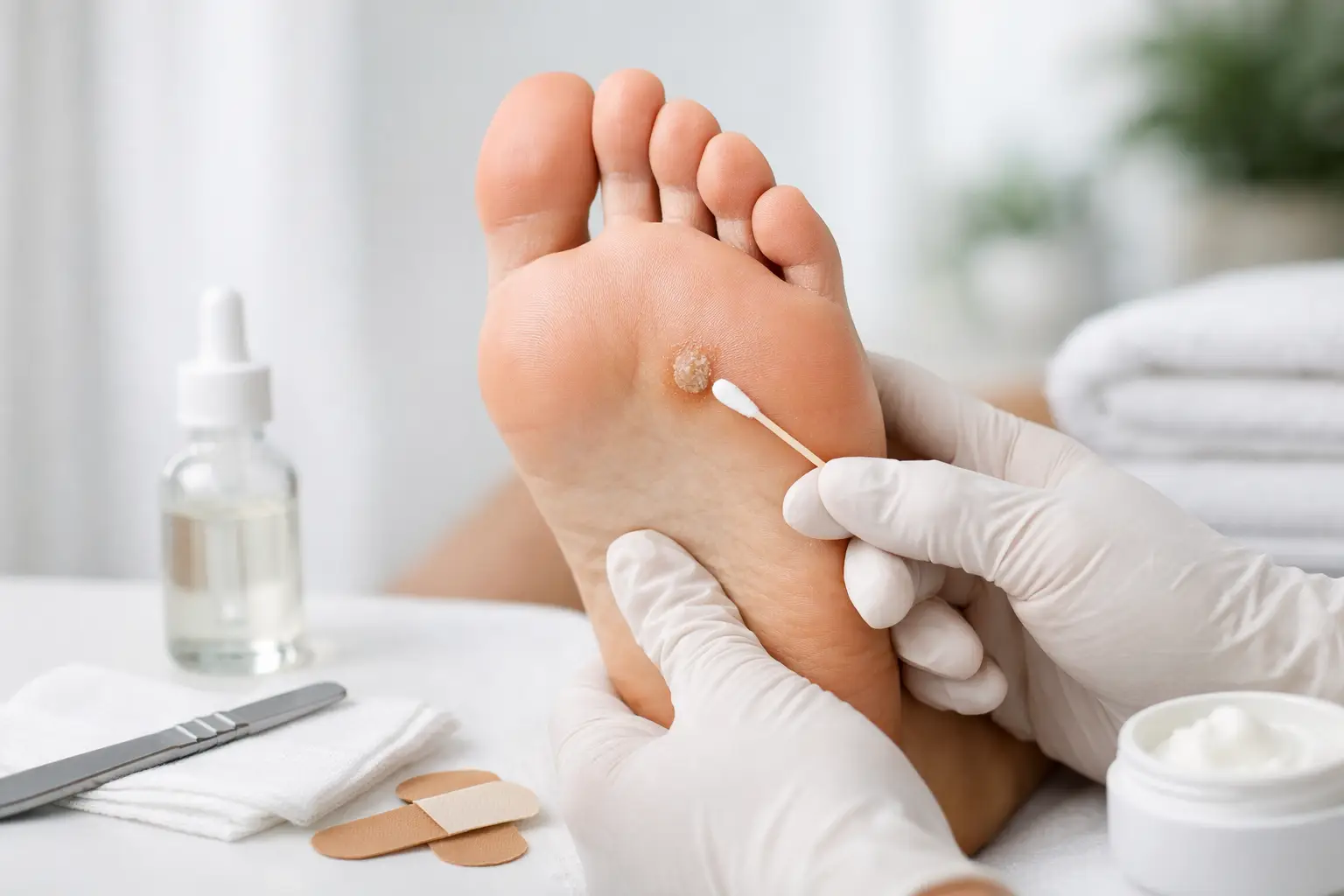
Best Ways to Treat Verrucas Effectively
A verruca can seem minor until it starts catching on your sock, hurting under pressure, or spreading to nearby skin. When patients ask about the best ways to treat verrucas, the right answer depends on where it is, how long it has been present, whether it is painful, and what treatments have already been tried.
Verrucas are caused by the human papillomavirus and usually appear on the soles of the feet or around the toes. Some stay small and settle without intervention. Others become stubborn, painful or multiple, particularly if they sit on a weight-bearing area or the skin is repeatedly irritated. That is why treatment is not simply a matter of choosing the strongest product available. It needs to be proportionate to the lesion and to the person.
What actually works for verrucas?
The most effective approach is usually the one matched to the diagnosis, the thickness of the overlying skin, and the level of persistence. A verruca hidden beneath heavy callus will often respond poorly if that hard skin is not addressed. Equally, a lesion that has been present for many months may need more than over-the-counter acids.
There is also a practical point that is often overlooked. Not every rough or painful patch of skin on the foot is a verruca. Corns, callus and other lesions can look similar, particularly to an untrained eye. If the diagnosis is wrong, the treatment tends to be wrong as well.
Best ways to treat verrucas at home
For recent, uncomplicated verrucas, home treatment can be reasonable. This is usually most suitable when the lesion is small, not especially painful, and the person does not have a medical condition that affects healing or circulation.
Salicylic acid remains one of the most widely used first-line treatments. It works by gradually breaking down the thickened skin over the verruca and encouraging the infected tissue to shed. The key word is gradually. This treatment often takes weeks, and sometimes longer, to show clear progress. It needs consistency rather than force.
Before applying it, the skin is usually best softened and the loose hard surface reduced carefully. That allows the treatment to reach the affected tissue more effectively. Applying acid to thick callus alone is unlikely to produce a good result. At the same time, aggressive cutting at home is not advisable, especially if the area is painful or prone to bleeding.
Occlusion methods, including covering the lesion, are sometimes discussed as a home option. Results are mixed. Some people feel they help; others see little change. They are generally low risk when used sensibly, but they are not a reliable substitute for proper treatment if the verruca is painful, spreading or long-standing.
Good foot hygiene also matters. Verrucas spread through viral particles shed from the skin, particularly in moist communal environments. Changing socks regularly, avoiding picking at the lesion, and using flip-flops in shared changing areas can reduce the chance of spread to other areas of your foot or to other people in the household.
When home treatment is unlikely to be enough
If a verruca has been present for months, hurts when you walk, keeps returning, or appears as a cluster, home care is less likely to be sufficient. The same applies if it sits beneath heavy callus or if previous pharmacy treatments have made the area sore without clearing it.
Certain patients should also avoid self-treating without clinical advice. That includes people with diabetes, peripheral vascular disease, reduced sensation, poor healing, or any condition that makes skin damage more risky. In those cases, even a treatment sold freely in a chemist may not be appropriate.
Children, pregnant patients and people with reduced immunity may also need more individual guidance. The issue is not that treatment is impossible, but that it should be chosen carefully.
Clinical verruca treatment options
A podiatry assessment helps establish whether the lesion is definitely a verruca, how extensive it is, and which treatment pathway is most appropriate. That matters because there is no single best treatment for every case.
Debridement is often the first practical step. This means reducing the overlying hard skin so the lesion can be properly assessed and, if needed, treated more effectively. In some cases, careful debridement and pressure management reduce symptoms significantly even before more targeted treatment begins.
Cryotherapy is one option patients often ask about, but results can be variable. Freezing aims to damage the affected tissue and stimulate an immune response, yet it is not always the most efficient choice for persistent plantar lesions. It can also be uncomfortable, and multiple appointments may be needed.
Acid treatment in clinic can be more controlled than home use. The strength, technique and frequency can be adjusted according to the lesion and surrounding skin. This tends to be more suitable when there is a need to balance effectiveness with protection of healthy tissue.
Two treatments often considered for stubborn verrucas are Swift microwave therapy and verruca needling. These are usually reserved for lesions that are persistent, painful, or resistant to standard care.
Swift microwave treatment
Swift uses microwave energy delivered directly to the verruca. The aim is not simply to burn the lesion away. It is designed to stimulate a local immune response so the body recognises and deals with the virus more effectively. This is one reason it can be useful for lesions that have lingered despite topical treatment.
The treatment itself is brief, although it can be uncomfortable during application. Most patients tolerate it well, but it is important to set expectations honestly. You may not see instant disappearance, and a course of treatment is often required. It is better understood as a structured clinical option for persistent verrucas rather than a one-visit quick fix.
Verruca needling
Verruca needling is another option for selected cases, particularly for stubborn lesions that have not responded to simpler treatment. Under local anaesthetic, the lesion is repeatedly punctured to introduce viral material deeper into the tissue and stimulate an immune response.
This is a more procedural treatment and is not the right first step for everyone. It can, however, be very effective in appropriately chosen cases. As with any intervention, suitability depends on the patient, the lesion and the wider clinical picture.
Which is the best way to treat verrucas?
The best ways to treat verrucas depend on the situation. For a small, recent lesion, salicylic acid with careful monitoring may be entirely reasonable. For a painful plantar verruca affecting walking, a more structured clinical approach is often the better route. For long-standing or recurrent verrucas, treatments such as Swift or needling may offer a better chance of resolution than repeated cycles of home products.
This is where assessment makes a difference. Rather than trying one treatment after another without a clear plan, it is usually more efficient to confirm the diagnosis, assess the depth and extent of the lesion, and choose the treatment based on what the tissue is actually doing.
Why some verrucas are difficult to clear
Verrucas can be unpredictable because the virus interacts with the immune system differently in different people. Some disappear with little input. Others persist despite repeated treatment. Pressure on the sole of the foot can also flatten the lesion inwards, making it appear less obvious while remaining painful and difficult to eradicate.
There is also a tendency to stop treatment too early. A verruca may look improved once the surface hard skin is reduced, but viral tissue can still remain. Equally, over-treating can irritate healthy skin and make walking more uncomfortable without improving the outcome.
When to book an assessment
If you are unsure whether it is a verruca, if it hurts when standing or walking, if it has spread, or if you have already tried pharmacy treatment without success, it is sensible to have it assessed. The same applies if you have any medical condition that affects circulation, nerve supply or healing.
At a clinic such as South London Foot Clinic, assessment is not just about naming the lesion. It is about understanding whether the skin needs reduction, whether the diagnosis is clear, whether pressure is aggravating symptoms, and which treatment is proportionate. That tends to save time and reduce the cycle of repeated self-treatment that often delays proper resolution.
Verrucas are common, but that does not mean they should be ignored if they are persistent or painful. The helpful starting point is not choosing the harshest treatment. It is choosing the right one for the lesion in front of you.