


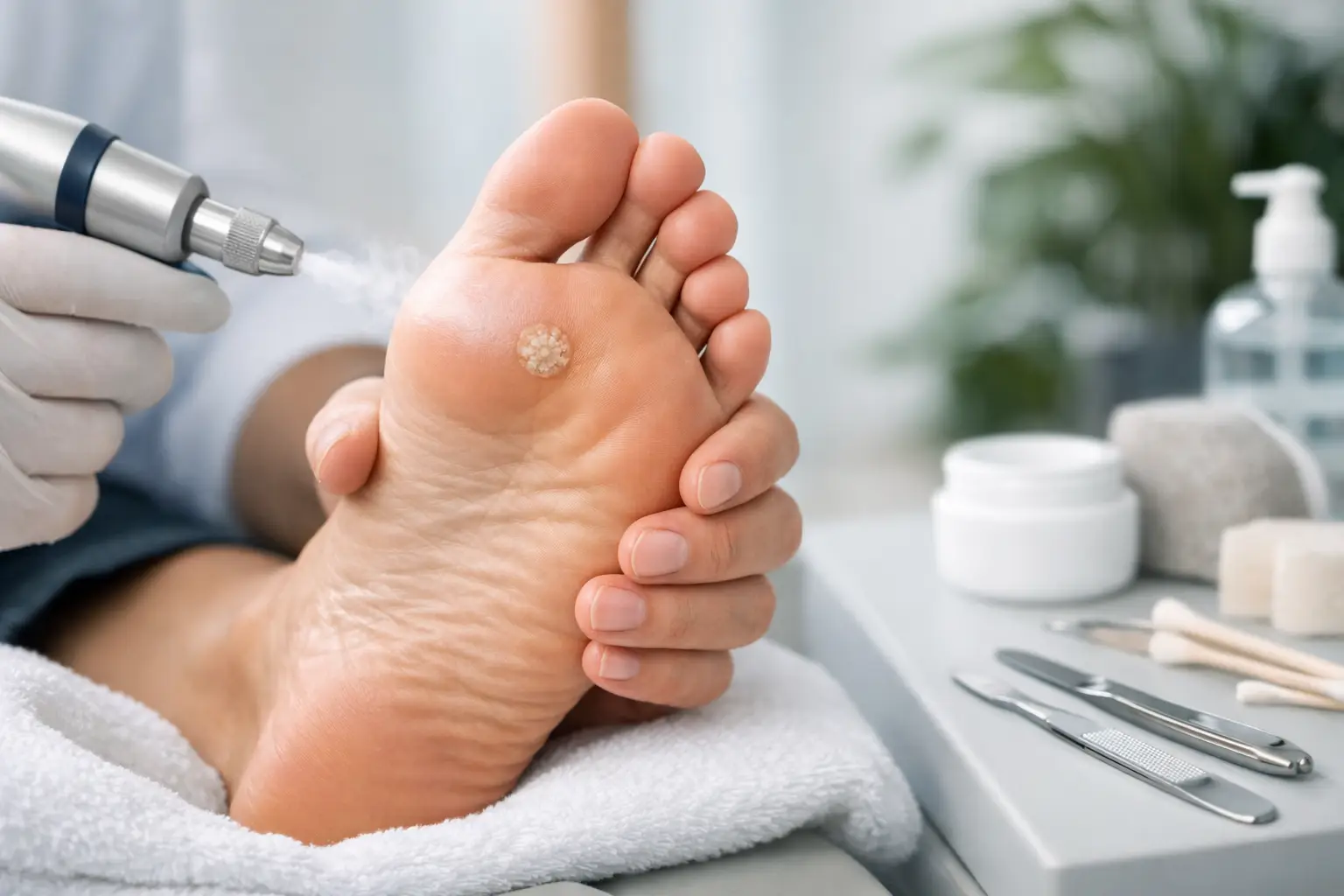
How to Get Rid of Verruca Safely
If you are searching for how to get rid of verruca, the first thing to know is that there is no single treatment that works quickly for everyone. Verrucae can be stubborn. Some clear with time or over-the-counter treatment, while others persist for months or return after seeming to settle. The right approach depends on the size, location, duration and how uncomfortable it is becoming.
A verruca is a wart on the sole of the foot, caused by the human papillomavirus. Because it sits on a weight-bearing surface, it often gets pushed inwards rather than growing outwards. That is why it can feel tender when walking and why it is sometimes mistaken for a corn. A proper assessment matters, particularly if you have had it for a while, if it is changing, or if previous treatment has failed.
What actually helps get rid of a verruca?
In practical terms, there are three broad routes. You can monitor it, treat it at home, or have it assessed and treated professionally. The right option depends on how much it is bothering you and how long it has been there.
Not every verruca needs aggressive treatment. In some people, the immune system eventually clears the virus without intervention. That can take a long time, and for adults it is often slower than expected. If the lesion is painful, spreading, affecting sport or work, or causing you to alter the way you walk, waiting is not always the most sensible option.
Home treatment can be reasonable for a small verruca that is not especially painful and has not been present for too long. The most common first-line option is salicylic acid. This works by gradually breaking down the infected skin. It is not a one-off treatment. It usually needs regular application over several weeks, often with careful filing of dead skin between treatments. Consistency matters more than intensity.
The difficulty is that people often stop too soon, treat the wrong diagnosis, or irritate the surrounding skin without making real progress. If the area becomes very sore, starts bleeding repeatedly, or you are unsure whether it is truly a verruca, it is worth pausing and getting it checked.
How to get rid of verruca at home
If you are trying home treatment, be realistic about the timeline. You are usually looking at weeks rather than days. After washing and drying the foot, salicylic acid is applied carefully to the lesion itself, avoiding healthy skin as far as possible. Some people protect the surrounding area with petroleum jelly before applying treatment.
Regular reduction of hard overlying skin can help the treatment penetrate more effectively, but this needs to be done gently. Over-trimming or picking at the area can increase pain and create unnecessary skin damage. Covering the lesion may also reduce friction, particularly if it is on a pressure point.
There are limits to self-treatment. Home freezing products are widely available, but they are generally less powerful than clinic-based treatments and can be disappointing for thicker or long-standing verrucae. They may still help some superficial lesions, but results vary.
You should avoid self-treatment if you have diabetes, poor circulation, reduced sensation in your feet, or any condition that affects healing. In those cases, even simple skin damage can become more significant than people expect.
When a verruca needs professional treatment
A podiatry assessment is often the better route if the verruca is painful, persistent, multiplying, or if you are no longer confident about what it is. Adults commonly present after months of trying different products with little change. By that stage, a structured treatment plan is usually more efficient than continuing with trial and error.
Professional assessment is not just about offering a stronger treatment. It starts with diagnosis. Verrucae can resemble corns, callus or other skin lesions, and treatment only makes sense once the cause is clear. The location, depth, pressure pattern and degree of pain all influence what is likely to work best.
For some patients, the main problem is not the virus itself but the pressure over it. Reducing that pressure can make walking more comfortable while treatment progresses. For others, the best option is a more definitive procedural treatment rather than another round of topical acids.
Clinical treatments for verrucae
There is no universal best treatment for every verruca. The most appropriate option depends on the lesion and the patient.
Routine debridement can reduce the thickened skin over the lesion, improve comfort and help topical treatment work more effectively. This does not remove the virus on its own, but it can be a useful part of management.
Acid-based treatments used in clinic are sometimes stronger and more targeted than over-the-counter products. These may suit some lesions, particularly where home treatment has been inconsistent or difficult to manage.
Cryotherapy is sometimes discussed, though outcomes can be mixed and it is not always the most effective option for plantar lesions. For this reason, many specialist clinics now focus on alternative treatments with better suitability for stubborn verrucae.
Swift verruca treatment uses microwave energy to stimulate an immune response within the affected tissue. It is often considered for persistent verrucae that have not responded to simpler measures. One advantage is that it targets the underlying issue without creating an open wound, and treatment sessions are usually brief. It is not completely pain-free, and not every patient is an ideal candidate, but it can be very effective in the right case.
Verruca needling is another option, typically used for more persistent or clustered lesions. This procedure is carried out under local anaesthetic. The aim is to drive infected tissue deeper into the skin to trigger a stronger immune response. It can be a useful choice where other methods have failed, although recovery and aftercare need to be discussed properly beforehand.
At South London Foot Clinic, treatment planning is based on assessment first, so the choice of treatment follows the diagnosis rather than the other way round. That tends to be the most sensible route when a lesion has become recurrent, painful or resistant.
How long does it take to get rid of a verruca?
This is where expectations need to be sensible. Even effective treatment is not always instant. Some verrucae respond within a few weeks, while others take longer and may need more than one session or a change in approach.
Duration is influenced by how long the verruca has been present, whether there are multiple lesions, the patient’s immune response, and whether pressure through the foot is repeatedly aggravating the area. A single small lesion in an otherwise healthy patient is very different from a mosaic verruca that has been present for over a year.
The aim is not just to attack the skin lesion. It is to clear the virus, reduce pain and lower the chance of recurrence. That is why structured follow-up can matter just as much as the first treatment.
Preventing spread and recurrence
Verrucae are contagious, but not everyone exposed will develop one. The virus tends to enter through tiny breaks in the skin, especially in moist communal environments such as changing rooms and poolside areas.
Simple steps can reduce spread. Avoid picking the lesion, keep the foot reasonably dry, do not share towels or footwear, and wear flip-flops in communal wet areas. If you file the verruca at home, use that tool only for the affected area and do not use it on healthy skin or nails.
Recurrence can happen even after treatment appears successful. That does not necessarily mean the treatment failed completely. Sometimes a small amount of infected tissue remains, or the immune response has not fully cleared the virus. Early review is sensible if the lesion starts to return.
When to book an assessment
If you have a painful lesion on the sole of the foot, it is reasonable to seek professional advice sooner rather than later if it has lasted more than a few months, is spreading, or is interfering with walking or activity. You should also arrange assessment if you are unsure whether it is a verruca, particularly if you have treated it repeatedly without improvement.
This matters even more if you have diabetes, circulatory problems, reduced sensation, or an immune-related condition. In those situations, self-treatment is not the safest starting point.
The most effective answer to how to get rid of verruca is usually the one that matches the diagnosis, the severity of the lesion and your wider foot health. Some cases do settle with patient, consistent home care. Others improve much faster once the lesion is properly assessed and a targeted treatment plan is put in place. If it is stopping you walking comfortably, it is worth treating it as a clinical problem rather than simply a nuisance.