


How to Manage Ankle Swelling Safely at Home
An ankle that has become noticeably puffy by the end of the day, after a twist, or following a long journey can be uncomfortable and concerning. Knowing how to manage ankle swelling starts with recognising that swelling is a symptom, not a diagnosis. It may reflect a minor soft-tissue injury, prolonged standing, reduced circulation, arthritis, medication effects or, less commonly, a condition requiring urgent medical attention.
The right approach depends on when the swelling started, whether it affects one or both ankles, and whether there is pain, heat, redness or difficulty walking. Simple measures can be useful for mild, short-lived swelling, but persistent or unexplained symptoms deserve a structured clinical assessment.
First, decide whether ankle swelling needs urgent attention
Do not rely on home care alone if swelling has appeared suddenly in one leg or ankle without an obvious injury, particularly if the calf is painful, tender, warm or red. These symptoms can be associated with a blood clot and require urgent medical advice. Seek emergency help if ankle or leg swelling occurs with chest pain, shortness of breath, coughing up blood, fainting or severe breathlessness.
Prompt assessment is also appropriate if you cannot bear weight after an injury, the ankle looks deformed, pain is severe, there is an open wound, or the foot becomes pale, blue, cold or numb. Infection may be a concern where the skin is hot, increasingly red, broken or leaking fluid, especially if you have diabetes, reduced sensation, poor circulation or a weakened immune system.
Swelling in both ankles that develops over days or weeks is not usually an emergency, but it should not be ignored if it is new, progressive or accompanied by breathlessness, fatigue, rapid weight gain or swelling elsewhere. Your GP may need to consider wider medical causes as well as lower-limb problems.
How to manage ankle swelling after a minor injury
A mild ankle sprain or knock commonly causes local swelling because injured tissues release fluid as part of the healing response. The aim during the first few days is to protect the area, control symptoms and avoid unnecessary aggravation without keeping the ankle completely still for too long.
Reduce load, but keep gentle movement
Avoid the activity that caused the pain, particularly running, jumping, uneven ground and sudden changes of direction. This is relative rest rather than complete rest. Once a fracture or serious injury is unlikely, gentle ankle movements can help prevent stiffness and encourage normal circulation.
While seated, slowly point the toes away and then draw them towards you. Make small ankle circles in each direction, staying within a comfortable range. Short, supported walks may be preferable to prolonged inactivity if you can walk without a significant limp. If walking causes sharp pain or the swelling increases substantially afterwards, reduce the load and arrange an assessment.
Elevate the ankle properly
Elevation can reduce the feeling of fullness and help fluid move away from the foot and ankle. Lie down and support the leg so that the ankle is above the level of the heart where practical. A few pillows under the calf usually work better than placing pressure directly under the heel.
Try this for 15 to 20 minutes at a time, several times through the day, particularly after being on your feet. Elevation is most useful for short-term symptom control. It will not correct an unstable ligament injury, tendon problem or circulation issue, which is why swelling that repeatedly returns needs further investigation.
Consider cooling for pain relief
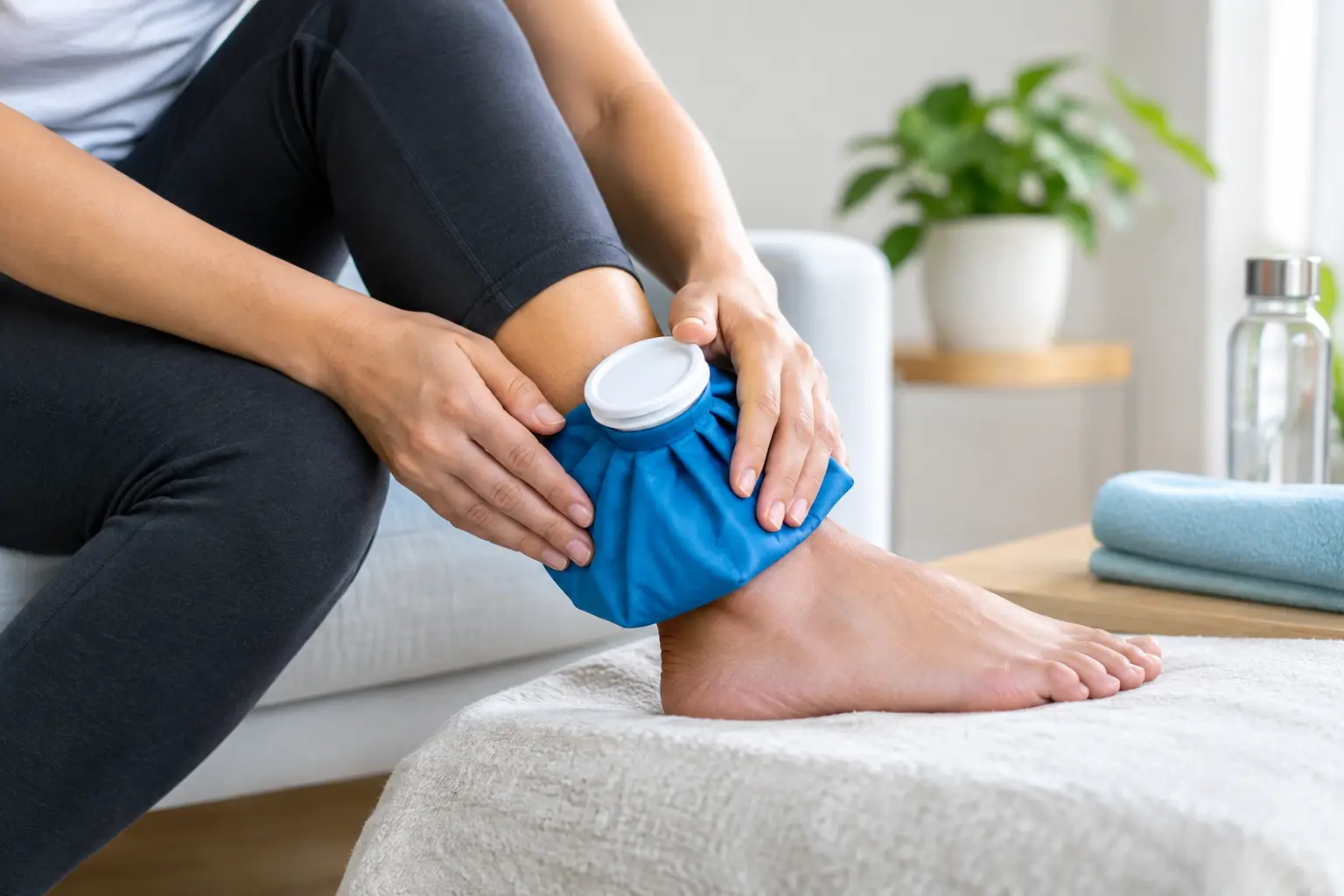
A cold pack wrapped in a thin towel may help reduce pain after a recent injury. Apply it for up to 15 minutes, then allow the skin to return to normal temperature before repeating. Do not place ice directly on the skin, and take particular care or seek advice first if you have reduced sensation, circulation problems or diabetes.
Cooling is optional. It can make an ankle feel more comfortable, but it is not a substitute for diagnosis, sensible loading and rehabilitation.
Use compression with care
A supportive elastic bandage or ankle support may reduce discomfort and give the joint a more secure feeling in the early stages of a minor sprain. It should feel supportive, not restrictive. Loosen or remove it if the toes tingle, become cold, change colour or feel increasingly painful.
Compression is not suitable for everyone. People with known arterial circulation problems, significant peripheral neuropathy or unexplained one-sided leg swelling should seek clinical advice before using compression garments or wraps. A support can also create false confidence, so avoid returning to sport simply because the ankle feels held in place.
Daily habits that may help swelling around both ankles
When swelling is linked to long periods sitting, standing or travelling, regular movement is often more helpful than one long exercise session. Every hour or so, walk briefly, rise onto your toes a few times, or move the ankles through their range of motion. The calf muscles act as a pump that assists the return of blood and fluid from the lower leg.
Choose footwear with enough depth and width to accommodate the foot comfortably. Shoes that are tight across the forefoot or ankle can worsen pressure and make the foot feel more swollen. If one pair of shoes suddenly feels tight every evening, take that change seriously rather than simply moving up a shoe size.
Hydration and a balanced diet support general health, but there is no quick dietary fix for significant ankle swelling. Reducing highly salty processed foods may help some people who retain fluid, particularly where this is already a recognised issue. Do not alter prescribed medication, including water tablets, without speaking to the clinician who manages it. Some medicines, such as certain blood pressure treatments, can contribute to ankle swelling and may need reviewing.
When swelling keeps returning
Recurrent swelling after sport, longer walks or work shifts may indicate more than a simple sprain. Ligament instability, tendon irritation, joint arthritis, impingement, a stress injury and poor load tolerance can all produce an ankle that swells repeatedly. The location matters: swelling around the outside of the ankle after a twist suggests a different set of structures from swelling behind the ankle, around the Achilles tendon, or at the front of the joint.
This is where a focused examination becomes valuable. A clinician will assess the pattern of swelling, joint movement, tenderness, strength, balance, walking pattern and the effect of specific movements. Diagnostic ultrasound may be appropriate where a tendon, ligament or fluid-related soft-tissue problem is suspected. It is not required for every swollen ankle, but used at the right point it can help clarify which tissues are involved and guide treatment planning.
Treatment should follow the diagnosis. Depending on the cause, this might include a graded rehabilitation programme, footwear advice, a brace, custom orthotics, hands-on treatment or a carefully considered injection procedure. More treatment is not automatically better. For example, an injection may have a role in selected inflammatory conditions but is not a first response to every painful, swollen ankle and is not appropriate where an unstable injury has been missed.
Avoid these common mistakes
Do not repeatedly test a sore ankle by running, playing football or taking a long walk to see whether it has improved. This can prolong inflammation and obscure how well the injury is actually settling. Equally, avoid immobilising a minor injury for weeks without advice, as stiffness and muscle weakness can make return to activity harder.
Painkillers may provide short-term relief, but they can mask symptoms that would otherwise tell you to reduce activity. Anti-inflammatory medicines are not suitable for everyone, particularly people with stomach ulcers, kidney disease, certain heart conditions, asthma affected by these medicines, or those taking anticoagulants. A pharmacist, GP or clinician can advise on the safest option for you.
A clear next step when you are unsure
If ankle swelling has not begun to improve after several days of sensible self-care, keeps returning, or limits work, exercise or normal walking, arrange an assessment rather than continuing to manage it by trial and error. At South London Foot Clinic, assessment is structured around understanding the cause first, with ultrasound incorporated where clinically indicated, before a treatment plan is discussed.
A swollen ankle often settles well when the underlying issue is identified early and the return to activity is properly paced. The useful question is not only how quickly the swelling can be reduced, but what is causing it and what will prevent it from becoming a recurring problem.