


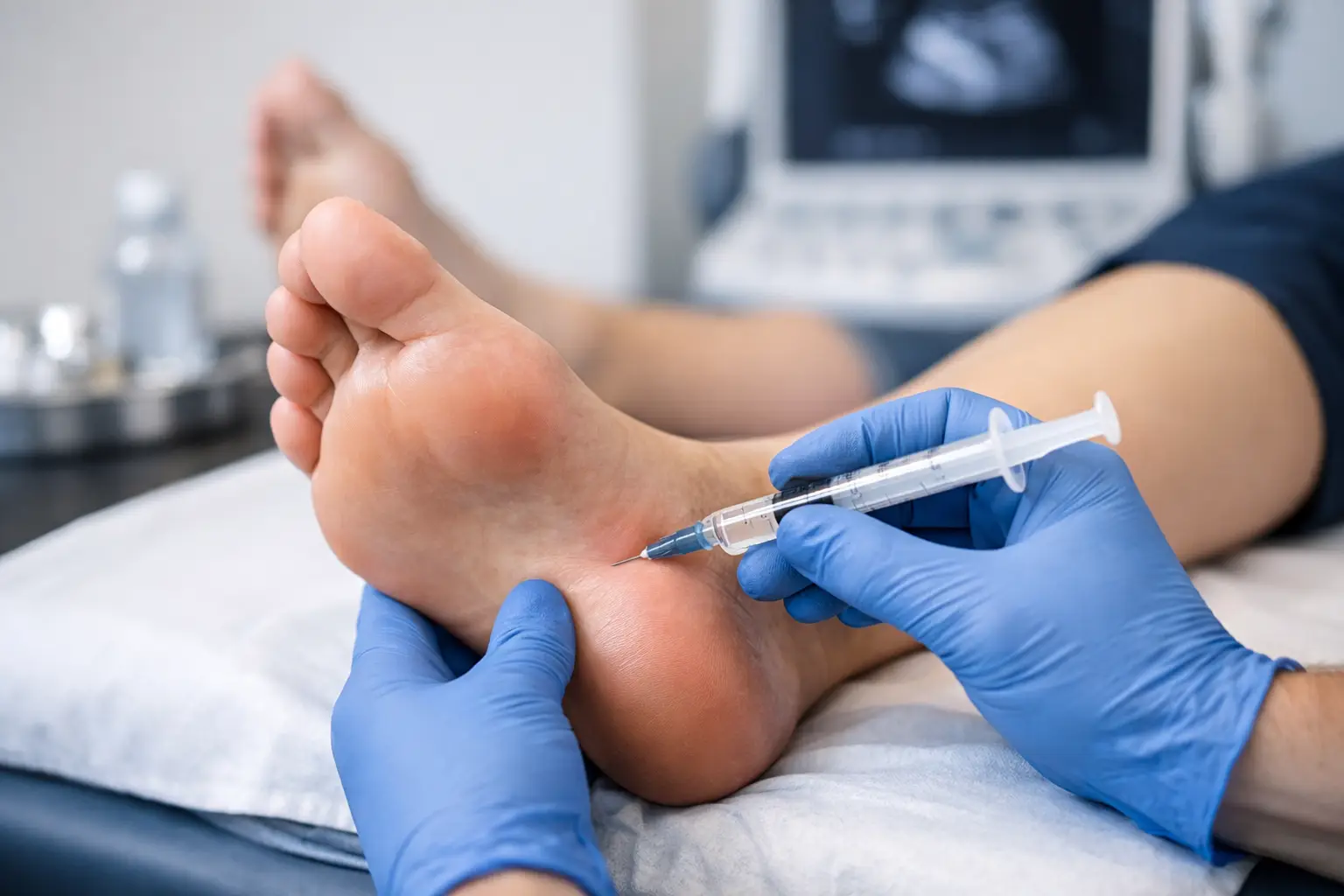
Steroid Injection for Heel Pain Explained
That first step out of bed can tell you a lot. If your heel pain is sharp, localised and stubborn despite rest, stretching or changing footwear, you may already have been told to consider a steroid injection for heel pain. The key question is not simply whether an injection is available, but whether it is the right treatment for the structure that is actually causing your symptoms.
Heel pain is common, but it is not one diagnosis. Pain under the heel may be linked to plantar fasciopathy, a bursa, a nerve, a fat pad problem or, less commonly, a stress-related issue. Pain at the back of the heel raises different possibilities again, such as insertional Achilles tendon problems or retrocalcaneal bursitis. Because the treatment needs to match the diagnosis, a careful assessment matters before any injection is considered.
When is a steroid injection for heel pain considered?
A steroid injection is usually considered when heel pain has not settled with more conservative treatment, or when pain levels are significantly limiting walking, work or exercise. It can reduce inflammation and irritation in certain conditions, which may allow symptoms to calm enough for rehabilitation to progress.
That said, a steroid injection is not a universal fix for every painful heel. In some cases it can be very helpful. In others, it may be inappropriate or offer only short-term relief if the underlying mechanics and tissue loading are not addressed. This is why a structured assessment is so important.
For plantar fasciopathy, for example, an injection may be discussed if symptoms are persistent and other treatment has not moved things forward. For bursitis around the heel, injection treatment may also have a role. For tendon pain, the decision becomes more selective because placing steroid near certain tendons can carry greater risk. The details matter.
Why diagnosis comes before treatment
Patients often arrive focused on the treatment they think they need. Understandably so – if you are limping, you want the pain reduced quickly. But good clinical care starts by identifying the pain source as accurately as possible.
A consultation should look at symptom history, aggravating activities, footwear, training load, foot posture, ankle movement and tissue tenderness. Where clinically indicated, diagnostic ultrasound can add another layer of clarity by showing the involved soft tissues in real time. That can help distinguish between plantar fascia thickening, bursitis, tendon pathology or other causes of pain.
This is particularly useful because heel pain can be deceptive. Two patients may both point to the same area, yet need completely different treatment plans. One may respond well to offloading and rehabilitation alone. Another may be a reasonable candidate for injection. Another may need further investigation rather than injection at all.
How the injection works
Steroid injections use a corticosteroid medicine, often combined with local anaesthetic. The aim is to reduce local inflammation and settle pain in a targeted area. This can improve comfort in the short term and sometimes break a cycle of persistent irritation.
The local anaesthetic may give temporary numbness or short-lived pain relief on the day. The steroid itself usually takes longer to have an effect. Some people notice improvement within a few days, while others take longer. Response is variable, and no responsible clinician should present it as guaranteed.
The practical benefit of reducing pain is that it may make it easier to walk more normally, tolerate exercises, or progress a rehabilitation plan. The limitation is that pain relief does not automatically mean the tissue has fully recovered. If the original overload, footwear issue or biomechanical driver remains unchanged, symptoms may return.
What conditions may respond well?
The most common reason people ask about a steroid injection for heel pain is plantar fasciopathy. This typically causes pain under the heel, often worse with first steps after rest and after prolonged standing or walking. In selected cases, injection can help reduce symptoms, particularly when pain has become persistent and is blocking recovery.
Steroid may also be considered around bursae, where inflammation is the main feature. At the back of the heel, this may be relevant if a retrocalcaneal bursa is involved. In these cases, accurate placement matters.
Where clinicians need to be more cautious is around tendons and certain tissue interfaces. Steroid can weaken tissues if used in the wrong place or too frequently. That is one reason thorough assessment and, where appropriate, image-guided planning are valuable. It is not simply a matter of finding a painful area and injecting it.
What are the risks and trade-offs?
A steroid injection can be effective, but it is not risk-free. The main risks depend on the structure being treated, the medication used and the individual patient. Short-term discomfort after the injection can happen. Some people experience a temporary flare in pain for a day or two.
There are also more specific risks. In the plantar heel, repeated injections may increase the risk of plantar fascia damage or fat pad problems. Around tendons, steroid exposure may increase the risk of weakening or rupture, which is why careful case selection is essential. Skin thinning, pigment change and infection are uncommon but recognised risks. Blood sugar can also rise temporarily in people with diabetes.
The trade-off is straightforward. If pain is severe and conservative treatment has stalled, an injection may help move things forward. But if it is used too early, or without a clear diagnosis, it can become a shortcut that does not solve the real problem. In many cases, the best outcomes come when injection is part of a wider treatment plan rather than the whole plan.
What happens after the injection?
After a heel injection, you are usually advised to reduce impact and keep activity sensible for a short period. That does not necessarily mean complete rest, but it does mean avoiding the temptation to test the heel because it feels better. Early overloading can undermine the benefit.
Recovery advice will depend on the diagnosis and injection site. Some patients need temporary offloading, changes in footwear, taping, stretching or calf work. Others benefit more from load management and progressive strengthening. If plantar fasciopathy is involved, support through orthotics or footwear advice may also be relevant.
This is where a structured clinic pathway makes a difference. The injection is one step. What matters next is whether the rehabilitation plan is clear, realistic and matched to the diagnosis.
When an injection is not the right answer
There are times when steroid is not the best option, even if the pain is significant. If there is concern about a stress injury, nerve entrapment, significant tendon degeneration or a condition where steroid may increase risk, another route may be safer and more effective.
There are also patients whose symptoms are improving steadily with conservative care. In that setting, adding an injection may offer little extra benefit. Equally, if poor footwear, abrupt training changes or prolonged standing demands are still driving overload, those factors need proper attention or the relief may be short-lived.
This is why a methodical approach matters more than a quick treatment decision. At South London Foot Clinic, that means assessing the problem first, using ultrasound where clinically indicated, and discussing whether injection is appropriate rather than assuming it is the default answer.
Questions worth asking before you go ahead
If you are considering an injection, it is sensible to ask what structure is being treated, why steroid is suitable in your case, what alternatives exist, and what the recovery plan will involve afterwards. Those questions are not a challenge to the clinician. They are part of informed treatment.
It is also reasonable to ask about expected timescales. Some heel pain settles relatively quickly once treatment is targeted properly. Other cases, especially long-standing plantar fascia pain, can take time even when the right approach is in place. Realistic expectations are better than false reassurance.
For many patients, the most reassuring part of the process is not the injection itself. It is understanding what is causing the pain, why a particular treatment has been chosen, and what happens next if symptoms improve only partly.
Heel pain rarely feels minor when it is affecting every step. A steroid injection may be a useful part of treatment, but the best starting point is always the same – make sure the diagnosis is clear, and let the treatment follow the cause rather than the other way round.