


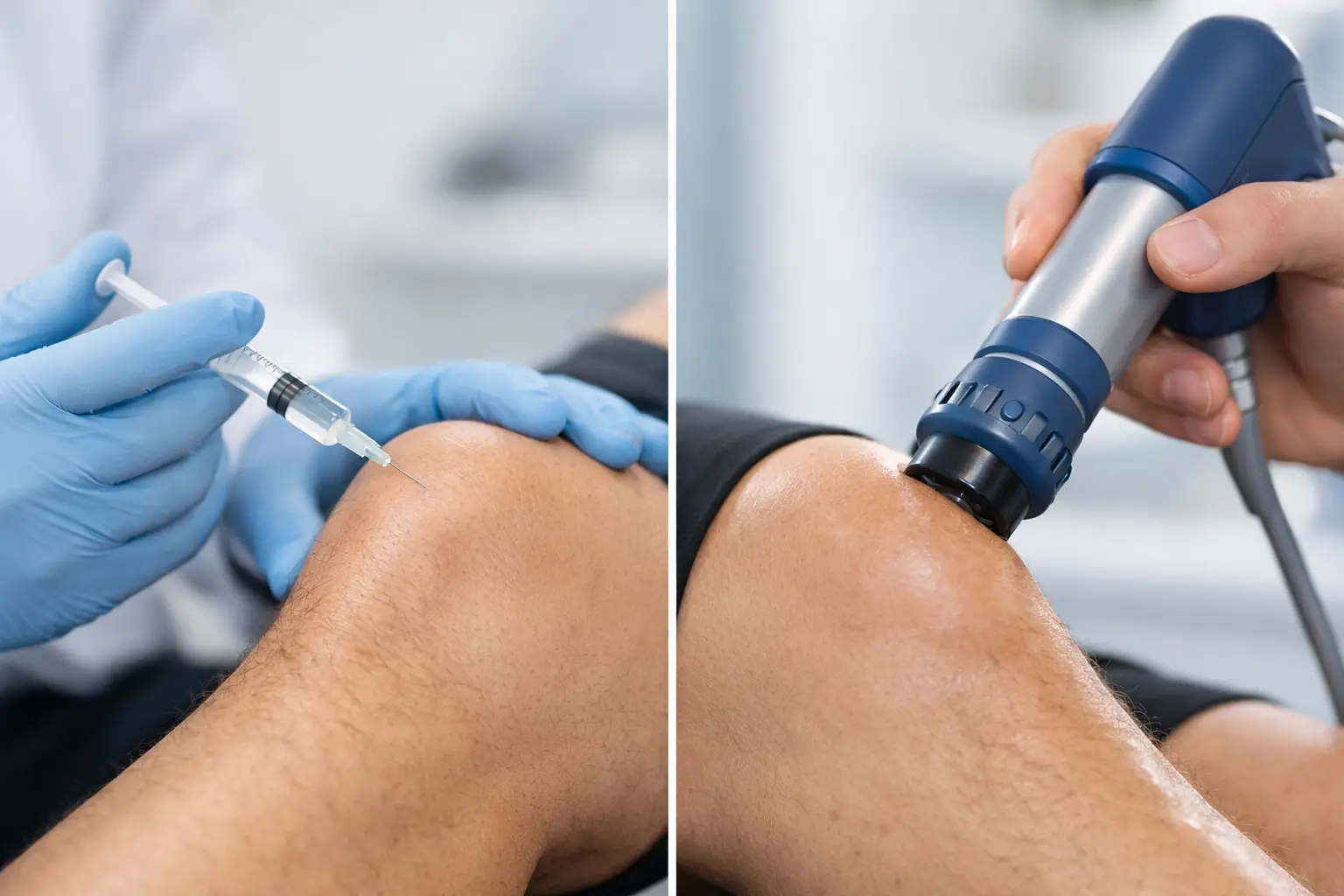
Steroid Injection vs Shockwave Therapy
When heel pain has been dragging on for months, the question is rarely whether you need treatment. It is which treatment is actually appropriate. In the discussion around steroid injection vs shockwave therapy, the right answer depends far less on preference and far more on diagnosis, tissue type and how long the problem has been present.
Patients often arrive having already read about both options, especially when dealing with plantar fasciitis, Achilles pain or other stubborn soft tissue injuries. Both treatments can be useful in the right setting. They are not interchangeable, and they should not be chosen simply because one sounds more advanced or offers the promise of quicker relief.
Steroid injection vs shockwave therapy – what is the difference?
A steroid injection is an anti-inflammatory treatment. It is designed to reduce pain and inflammation in a specific area, usually when the irritated tissue or surrounding structures are significantly painful and not settling with simpler measures. In foot and ankle practice, this may be considered for conditions such as plantar fasciitis, bursitis, joint inflammation or some nerve-related pain, depending on the clinical picture.
Shockwave therapy works differently. It is a mechanical treatment that delivers pulses of energy into the affected tissue. The aim is not to numb the problem or suppress inflammation in the short term, but to stimulate healing activity in tissue that has become chronically painful and slow to recover. It is often used for longstanding tendon and fascia problems, particularly where symptoms have persisted despite rest, footwear changes, stretching or rehabilitation.
That difference matters. If the main issue is active inflammation in a structure that is acutely irritated, a steroid injection may have a role. If the issue is a chronic, degenerative tendon or fascial problem that needs stimulation and a structured loading plan, shockwave therapy may make more sense.
Why diagnosis comes before treatment choice
The phrase steroid injection vs shockwave therapy sounds like a simple comparison, but in clinic it is rarely a straight either-or decision. Before recommending either option, the first step is to establish what tissue is involved and why it is painful.
Heel pain is a good example. One person may have plantar fasciitis. Another may have a plantar fascia tear, a nerve irritation, fat pad pain or a stress response in the calcaneus. These can feel similar to the patient, but they are managed differently. Treating the wrong problem with the wrong intervention can delay recovery rather than speed it up.
That is why a structured assessment matters. History, examination and, where clinically indicated, diagnostic ultrasound help clarify whether the tissue appears thickened, inflamed, torn or degenerative. The treatment plan should follow that information, not the other way round.
When a steroid injection may be more appropriate
Steroid injections are usually considered when pain is limiting day-to-day function and there is a clear target for treatment. In the foot and ankle, they can be useful where inflammation is a major driver of symptoms and where reducing that inflammatory response may create a window for rehabilitation.
For some patients with severe plantar heel pain, a steroid injection can provide relatively quick symptom relief. That can make walking easier and allow progress with calf work, footwear adjustment and activity modification. In a joint problem, such as an inflamed arthritic joint, injection may also be an effective way to settle symptoms locally.
However, steroid is not a repair treatment. It may reduce pain, but it does not rebuild damaged tendon or fascia. It also comes with limits. Repeated injections into some tissues are not advisable, and steroid use around tendons requires particular caution because of the potential effect on tissue strength. Timing, location and indication all matter.
Patients sometimes think of injection as the strongest treatment available. Clinically, that is not how it should be viewed. It is one tool, used selectively, when the diagnosis supports it.
When shockwave therapy may be more appropriate
Shockwave therapy is more commonly used for persistent soft tissue pain that has not improved with initial conservative care. It is often considered for chronic plantar fasciitis, Achilles tendinopathy and other enthesopathies, where the tissue has become painful over time and normal healing has stalled.
This can suit patients who have had symptoms for several months, particularly if the pain is worse with first steps, after loading or after periods of inactivity, and imaging supports a chronic rather than acute pattern. Shockwave is usually delivered as a course of treatments rather than a single intervention, and it works best when combined with a broader plan rather than as a standalone fix.
That broader plan may include activity modification, footwear advice, calf strengthening, tendon loading or orthotic support. In other words, shockwave therapy is often part of rehabilitation, not a substitute for it.
Patients should also know that shockwave is not always comfortable. Symptoms can briefly flare after treatment, and improvement is often gradual rather than immediate. For the right condition, that slower pattern can still be entirely appropriate because the goal is tissue recovery rather than short-lived suppression of pain.
Benefits and trade-offs of each option
Steroid injection has the advantage of speed. Where it is well indicated, it may reduce pain relatively quickly and help settle a highly irritable area. That can be especially valuable when walking is significantly affected or when progress has stalled because symptoms remain too reactive.
The trade-off is that relief may be temporary, and it can create a misleading sense that the issue has fully resolved. If return to activity is too quick, symptoms may recur. There are also recognised risks, including post-injection flare, skin or fat pad changes in some locations, infection risk and concerns around repeated use in vulnerable tissues.
Shockwave therapy has a different set of strengths. It is often favoured in chronic cases because it aims to stimulate healing in tissue that is not recovering normally. It avoids steroid exposure and may be better suited to degenerative tendon and fascial conditions.
The trade-off is that it requires patience. It usually involves multiple appointments, discomfort during treatment is common, and not every patient responds. It is also less useful where the diagnosis points to a problem that is not primarily a chronic tendon or fascia disorder.
Which treatment is better for plantar fasciitis?
This is one of the most common questions, and the honest answer is that it depends on the stage and nature of the condition.
In more acute or highly inflammatory presentations, a carefully selected steroid injection may help reduce pain, particularly if symptoms are severe and function is poor. In longstanding plantar fasciitis, especially where ultrasound suggests thickened, chronically irritated fascia rather than an acute flare alone, shockwave therapy may be the more appropriate option.
There are also cases where neither should be first-line treatment. If the problem appears to be driven by overload, poor calf capacity, footwear issues or biomechanical strain, the core work may still be rehabilitation, temporary offloading and support. Treatment should be built around what is causing the fascia to stay irritated.
Why one patient improves and another does not
Response to treatment is influenced by more than the treatment itself. Duration of symptoms, bodyweight, training load, work demands, footwear, diabetes, inflammatory disease and previous injury can all affect recovery.
This is why blanket advice can be unhelpful. A runner with insertional Achilles pain, a teacher standing all day with plantar heel pain, and someone with midfoot arthritis may all ask about the same two treatments, but the clinical reasoning will be different in each case.
At South London Foot Clinic, that is why treatment recommendations are based on assessment first, with diagnostic ultrasound used when it helps confirm the tissue involved and guide a more precise plan. That level of clarity is often what patients need most, particularly when they have already tried rest, online exercises or previous treatment elsewhere without lasting improvement.
What should you expect before deciding?
A good consultation should explain what the diagnosis is, whether the tissue looks inflamed, degenerative or structurally compromised, and what each treatment is realistically trying to achieve. It should also cover what happens afterwards.
For a steroid injection, that means understanding aftercare, temporary activity restriction and the reason it is being used. For shockwave therapy, that means knowing how many sessions are expected, how symptoms may respond between appointments and what rehabilitation should run alongside it.
The most helpful treatment plan is rarely the one that sounds the quickest. It is the one that matches the tissue, the timescale of the problem and the demands of your normal life.
If you are weighing up steroid injection vs shockwave therapy, the key question is not which treatment is better in general. It is which one makes clinical sense for your specific diagnosis, and whether it fits into a structured recovery plan that gives the tissue its best chance to settle properly.