


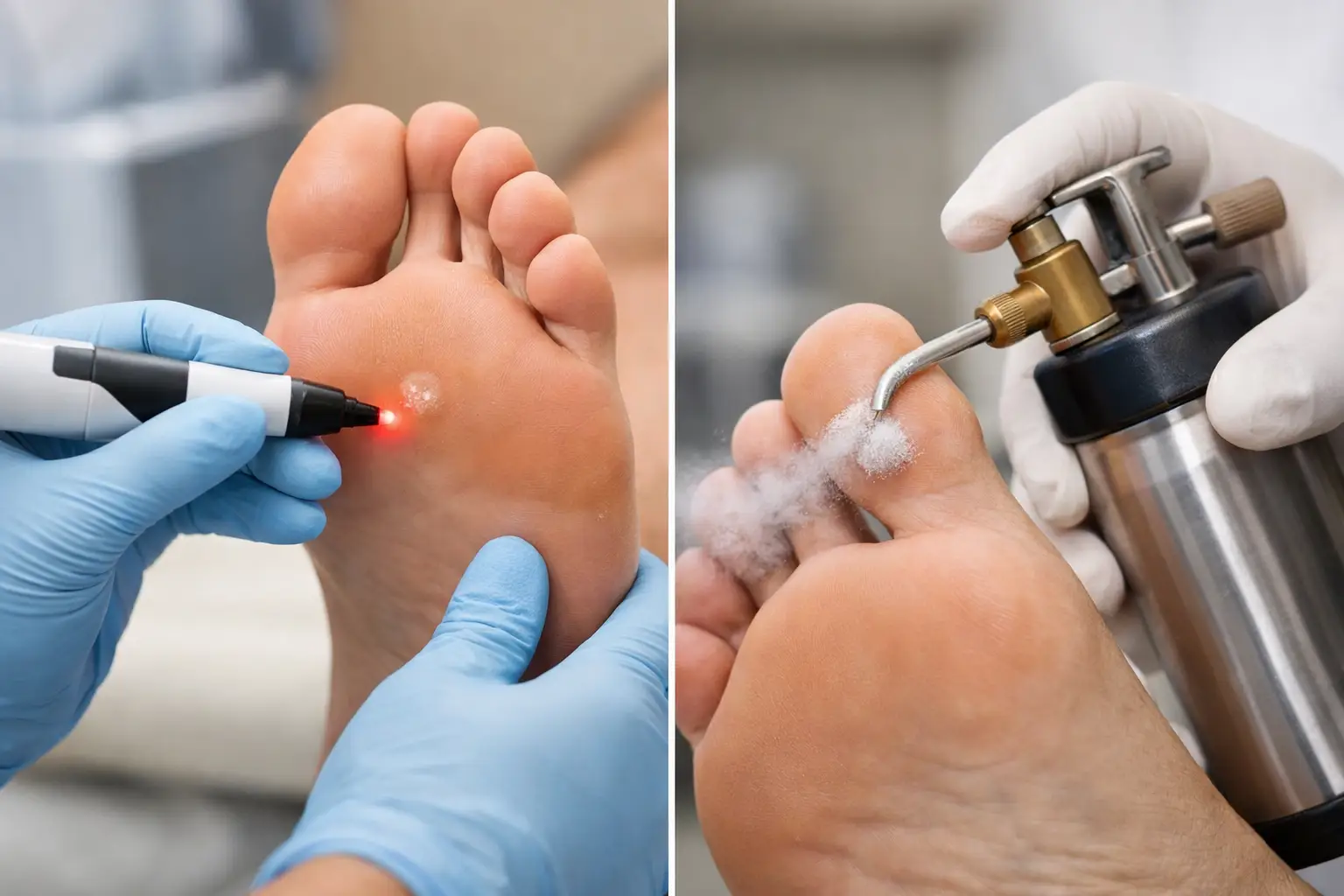
Swift Verruca Treatment vs Freezing
Most people compare Swift verruca treatment vs freezing when a verruca has stopped being a minor annoyance and started interfering with daily life. That usually happens when it becomes painful under pressure, proves stubborn after pharmacy treatments, or keeps returning despite repeated attempts to clear it.
At that point, the real question is not simply which treatment sounds more advanced. It is which option is more appropriate for the type of verruca you have, how long it has been present, how sensitive the area is, and how much treatment downtime you are willing to accept. A proper podiatry assessment matters because verrucae do not all behave in the same way.
Swift verruca treatment vs freezing – what is the difference?
Although both treatments aim to clear verrucae, they work in very different ways.
Freezing, also called cryotherapy, uses extreme cold to damage the verruca tissue. The intention is to create a local destructive effect so the infected skin breaks down over time. It has been used for many years and is familiar to many patients because it is also used for other skin lesions.
Swift treatment uses microwave energy delivered through a probe placed on the skin. Rather than freezing or cutting the lesion away, it creates a controlled heat effect within the tissue. This is designed to stimulate an immune response against the virus that causes the verruca. In practical terms, freezing is more directly destructive to the tissue, while Swift is intended to help the body recognise and clear the infection.
That difference in mechanism is one reason the patient experience can vary quite a lot between the two.
How freezing works in practice
Cryotherapy is usually delivered in clinic using a very cold spray or probe. The treatment itself is often brief, but it can sting sharply during application and may continue to feel sore afterwards. Some patients develop blistering, tenderness or irritation around the treated area.
For a small, relatively new verruca, freezing can sometimes be a reasonable first-line option. It is widely understood, and some patients prefer it because it sounds straightforward. However, the response can be unpredictable. Some verrucae improve, others show little change, and some require repeated appointments without fully resolving.
This is particularly relevant on weight-bearing areas of the foot. If the lesion sits under the heel or forefoot, post-treatment soreness can be inconvenient. Even when the treatment session is short, the after-effects may make walking uncomfortable for a period.
How Swift treatment works in practice
Swift is typically delivered in short pulses during a clinic appointment. The application itself is quick, though patients often describe each pulse as intense. The discomfort is usually concentrated into a short treatment window rather than lingering for days in the same way tissue-destructive treatments sometimes can.
A key point is that the skin surface is not being frozen or burned away in the traditional sense. Because of that, there is often less dressing, less wound-style aftercare and less interruption to normal activity. For many patients, the attraction is not that it is sensation-free – it is not – but that the treatment is structured, brief and often easier to fit around work and commuting.
Swift is often considered for persistent verrucae, recurring lesions, or cases where previous topical treatment and freezing have not worked. It can also be useful when the aim is to avoid repeated skin damage in an already tender area.
Which treatment is more painful?
Pain is one of the first things patients ask about, and rightly so. The honest answer is that both can be uncomfortable, but in different ways.
Freezing tends to produce a sharp cold burn sensation during treatment, followed in some cases by throbbing, blistering or soreness afterwards. For some people that after-pain is manageable. For others, especially when the verruca is on a pressure point, it is the part they find most disruptive.
Swift often produces a strong, short-lived pain during each microwave pulse. Many patients tolerate this well because the discomfort passes quickly once the pulse ends. The session can feel intense, but the recovery is often simpler.
Pain tolerance varies, and so does verruca location. A lesion under the ball of the foot may feel different from one at the side of a toe. This is why treatment choice should not be based on a blanket statement that one option is painless and the other is not. Neither treatment should be sold that way.
Success rates and why they are hard to compare
Patients naturally want a clear answer on which treatment works best. The difficulty is that verruca outcomes depend on more than the treatment itself.
Age, immune response, the duration of the verruca, previous failed treatments, lesion size, whether there is a single lesion or a mosaic pattern, and whether the patient has been picking or self-treating the area all influence the result. That means headline success rates should be interpreted with caution.
In clinical practice, Swift is often chosen because it can perform well in stubborn cases where more traditional approaches have been disappointing. That does not mean freezing has no role. It means the right treatment depends on the presentation. A small verruca present for a short time may be managed differently from one that has persisted for years.
A consultation-led approach is useful here because it allows the lesion to be examined properly, the diagnosis confirmed, and a realistic plan discussed rather than promising a guaranteed cure.
When freezing may be the better option
Freezing may still be appropriate if the verruca is relatively small, not especially deep, and the patient is comfortable with the possibility of local blistering or tenderness afterwards. It may also suit someone who wants a more traditional treatment route before considering newer modalities.
It can be a reasonable option when expectations are clear from the outset. That means understanding that several sessions may be needed and that response is variable. If the lesion does not improve, it is sensible to review the diagnosis and the treatment plan rather than simply repeating the same intervention indefinitely.
When Swift may be the better option
Swift is often attractive for adults with persistent or painful verrucae, especially when the lesion has already resisted over-the-counter acids, cryotherapy or repeated home care. It may also be better suited to patients who want a treatment pathway with less wound-type aftercare and less disruption between appointments.
For busy London patients, that practical point matters. If you commute, stand for work, exercise regularly or simply do not want prolonged tenderness after each session, treatment recovery becomes part of the decision.
At a clinic such as South London Foot Clinic, that decision should sit within a proper assessment rather than being made on marketing claims alone. The aim is to match treatment to the lesion, the patient and the likely response, not just to recommend the newest option by default.
Factors that matter more than the treatment name
The method itself is only one part of successful care. Diagnosis comes first. Not every lesion on the sole is a verruca, and thickened painful skin can sometimes be mistaken for one. If the diagnosis is wrong, the treatment is unlikely to work well.
It also matters whether there is one isolated lesion or a cluster, whether pain is coming from the verruca itself or surrounding pressure, and whether there are any medical factors affecting healing or sensation. A good consultation should cover these points clearly.
Patients are often relieved when this is explained properly. It changes the conversation from, “Which treatment is best?” to, “Which treatment makes clinical sense for my foot?”
Cost, convenience and expectations
Cost is part of the decision for most people, and it should be discussed openly. Freezing may appear simpler at first glance, but repeated appointments can add up if the response is slow. Swift may involve a different fee structure, yet some patients prefer it because the treatment pathway is more defined.
Convenience matters as well. If a treatment leaves you hobbling for several days after each session, that has a cost of its own, even if it is not listed on an invoice. On the other hand, if you are highly pain-sensitive during procedures, you may need to weigh the brief intensity of Swift against the different pattern of discomfort associated with freezing.
The most useful expectation is this: neither treatment is magic, both can work, and both are better chosen after assessment than by guesswork.
So, how should you choose?
If you are weighing up Swift verruca treatment vs freezing, the best next step is not to pick whichever sounds strongest. It is to have the verruca assessed properly, confirm the diagnosis, and discuss what is realistic based on how long it has been there, where it sits on the foot and how it has responded so far.
For some patients, freezing remains a reasonable option. For others, particularly with persistent or recurrent verrucae, Swift may offer a more suitable route. The difference is not only about technology. It is about choosing a treatment plan that is clinically justified, clearly explained and workable in day-to-day life.
A stubborn verruca can feel surprisingly wearing, especially when every step reminds you it is still there. The right treatment starts with clarity, and that usually makes the path forward much simpler.