


When Do You Need Nail Surgery?
A nail that keeps catching in the skin can start as a nuisance and end up affecting how you walk, exercise and get through the day. If you are wondering when do you need nail surgery, the answer usually comes down to one thing: whether the nail can settle with conservative care, or whether it is repeatedly causing pain, infection or ongoing damage to the surrounding skin.
Nail surgery is a common podiatry procedure used to treat part or all of a problematic toenail, most often an ingrown toenail. It is not the first step for every sore nail, and it is rarely recommended without proper assessment. The decision should be based on the condition of the nail, the severity of symptoms, how long the problem has been present and whether simpler treatment has already failed.
When do you need nail surgery for an ingrown toenail?
In most cases, nail surgery is considered when an ingrown toenail becomes recurrent, infected or too painful to manage safely with routine care alone. A mildly irritated nail edge may improve with careful trimming, pressure relief, footwear changes and treatment of any local inflammation. That is very different from a nail that repeatedly pierces the skin, produces discharge or causes enough pain to limit walking.
A podiatrist will usually think about nail surgery when the problem is not simply a one-off episode. If the same side of the nail keeps growing into the skin, conservative treatment may only provide short-term relief. Removing the offending section of nail, and often treating the nail root on that side, can stop that edge growing back and prevent the cycle from continuing.
This tends to be the most predictable option when the nail shape itself is the reason for the problem. Curved or involuted nails, thickened nails and nails damaged by trauma often do not behave well with repeated temporary trimming.
Signs that conservative care may no longer be enough
Pain is usually the symptom that brings people in, but pain alone does not automatically mean surgery is needed. The broader picture matters. A nail may need a procedural solution if there is persistent swelling along the nail border, redness that keeps returning, bleeding, discharge, overgrown granulation tissue or repeated infection.
Another important sign is recurrence. If you have had the nail cut back several times, either by yourself or by a clinician, and the problem keeps returning within weeks or months, that often suggests the shape or growth pattern of the nail is the underlying issue. In that situation, routine trimming may be managing the symptom rather than solving the cause.
Difficulty wearing normal shoes can also be a factor. Patients often adapt gradually without realising how much the nail is affecting them. They avoid certain trainers, stop longer walks or change how they load the foot to avoid pressure. That may seem manageable at first, but it can become a persistent source of discomfort.
Conditions that may lead to nail surgery
The most common reason for nail surgery is an ingrown toenail, but it is not the only one. Some patients need treatment because the nail is thickened, distorted or repeatedly painful after previous injury. Others have a nail that has become chronically infected or separated from the nail bed and is no longer growing in a healthy way.
Fungal nail changes on their own do not usually mean surgery is required. However, if a fungal nail becomes grossly thickened, painful in footwear or impossible to manage conservatively, surgical removal may sometimes be considered. Trauma is another example. A damaged nail matrix can produce a nail that grows back misshapen and continues to cause pressure or recurrent ingrowing.
The key point is that surgery is recommended because of function and symptoms, not simply appearance. A nail that looks abnormal but causes no pain or skin breakdown is approached differently from a nail that is repeatedly inflamed and limiting day-to-day activity.
What nail surgery actually involves
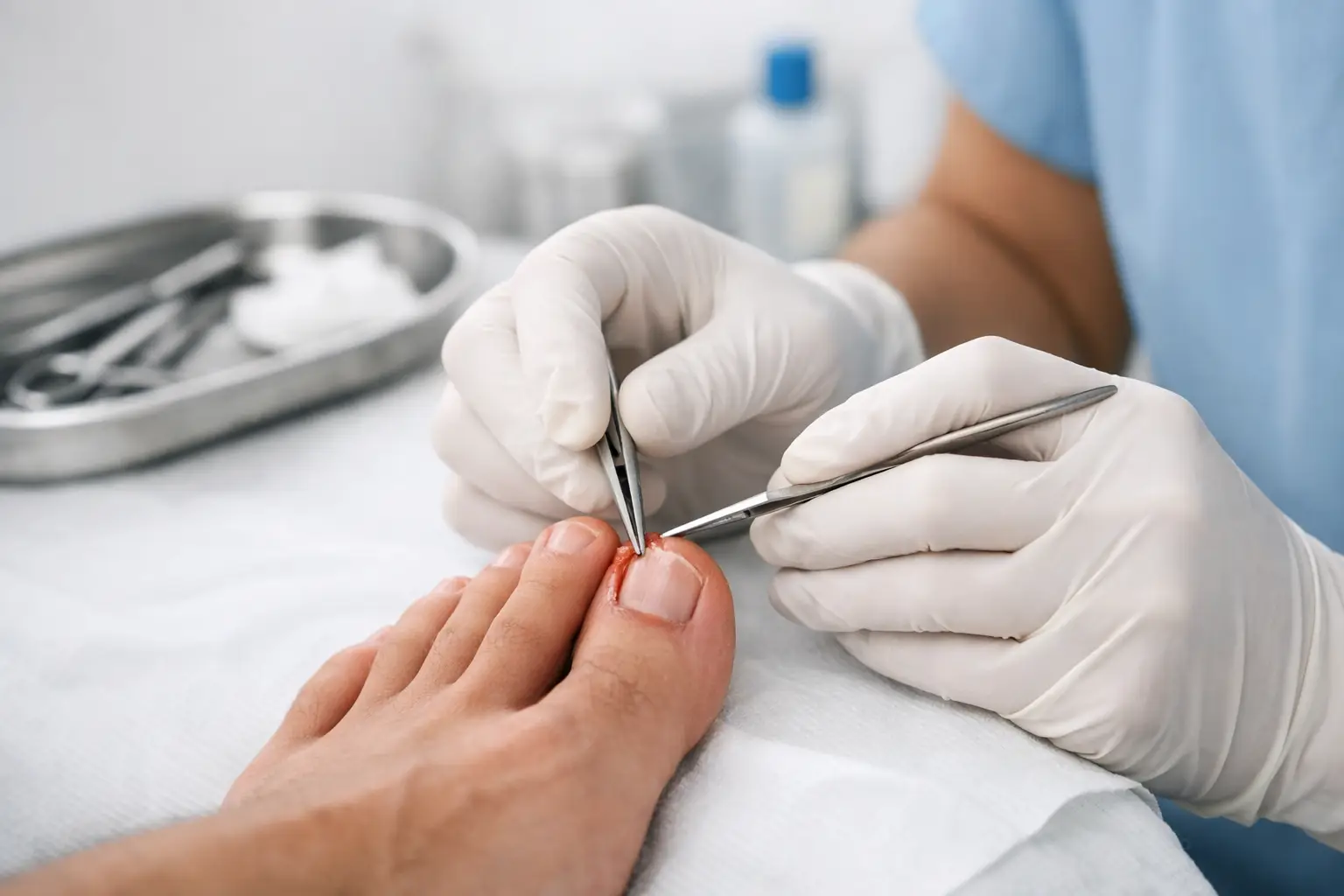
Many patients imagine nail surgery to be far more invasive than it is. In podiatry practice, it is usually a minor procedure performed under local anaesthetic. Once the toe is numb, the problematic section of nail, or occasionally the whole nail, is removed. If the goal is to stop that part of the nail returning, the nail matrix is treated with a chemical called phenol.
In straightforward cases, this is a planned and well-tolerated procedure. The toe is dressed afterwards, and you are given clear instructions about redressing, activity and what to expect as it heals. There is usually some drainage from the site while the area settles, which is normal after a phenol procedure.
Whether part or all of the nail is removed depends on the pattern of the problem. For a nail ingrowing down one side, a partial nail avulsion is often enough. For a severely deformed or repeatedly problematic nail, total nail removal may be more appropriate. That decision should be made after examination rather than assumption.
When assessment matters most
Not every painful toenail should go straight to surgery. Some cases look like ingrown nails but are mainly driven by infection, trauma, skin disease or pressure from footwear. Others involve circulation issues, diabetes or delayed healing risk, which may change how treatment is planned.
That is why a structured assessment matters. Before recommending a procedure, a podiatrist should examine the toe, check for infection, review your medical history and discuss what has already been tried. In some cases, particularly when there is significant swelling, unusual tissue change or uncertainty about the diagnosis, further assessment may be needed before treatment is booked.
A methodical approach avoids unnecessary procedures and helps match treatment to the actual cause. At South London Foot Clinic, that emphasis on diagnosis first is built into the wider treatment model, so patients understand what is driving the problem before decisions are made.
Situations where nail surgery may be delayed or modified
Even when nail surgery is the right treatment, timing can matter. If there is severe acute infection, cellulitis or a high-risk medical background, the first priority may be stabilising the condition rather than proceeding immediately. Some patients require antibiotic management through their GP alongside podiatry care, although antibiotics alone do not correct an ingrowing nail.
Healing risk also needs proper consideration. Patients with poor circulation, reduced immune function or poorly controlled diabetes may still be suitable for nail surgery, but only with the right precautions and clear clinical reasoning. This is another reason self-diagnosis is unreliable. What looks like a simple nail problem can carry more complexity than expected.
Pregnancy, anticoagulant use and allergy history may also influence planning. None of these automatically rule the procedure out, but they should always form part of the discussion.
What recovery is usually like
Recovery is generally straightforward, but it is not instant. Most patients can walk out after the procedure, although the toe remains numb for a few hours and activity usually needs to be reduced initially. You may need open or roomy footwear for a short period, especially if the toe was very inflamed beforehand.
Healing time varies. A partial nail procedure often settles within a few weeks, but full healing can take longer depending on the extent of treatment, your health status and how inflamed the toe was to begin with. The aim is not just to remove pain on the day, but to create a stable long-term result.
That trade-off is worth discussing clearly. Nail surgery is highly effective, but it does involve a recovery period, regular dressing changes and temporary inconvenience. For most patients with recurrent ingrowing nails, that short-term disruption is preferable to repeated pain and infection.
Is nail surgery permanent?
It can be. If phenol is used to treat the nail root, the intention is usually to stop the removed section from growing back. No procedure offers an absolute guarantee, but success rates are generally very good when the diagnosis is correct and aftercare is followed properly.
If a simple temporary removal is performed without treating the matrix, the nail is expected to regrow. That may be appropriate in selected cases, but it is less useful when the main issue is a chronic recurring nail edge. Again, the right option depends on the reason the nail is causing problems in the first place.
When to seek help rather than wait it out
If your toenail is painful, red, swollen, leaking or repeatedly catching in the skin, it is worth having it assessed before it worsens. The earlier a nail problem is examined, the more treatment options are usually available. Waiting until there is severe pain, obvious infection or excessive tissue overgrowth can make the course longer and more uncomfortable.
A good consultation should leave you with a clear answer about what is happening, whether surgery is necessary and what the realistic alternatives are. For some patients, routine podiatry care and footwear advice will be enough. For others, a minor procedure is the most reliable way to stop a persistent problem from returning.
If a nail keeps becoming part of your life in all the wrong ways, the useful question is not whether you can put up with it for another month. It is whether the current approach is actually solving it.