

Custom Orthotics Review: Do They Really Help?
If you have been told you “might need insoles”, a proper custom orthotics review matters more than most people realise. The difference between a device that eases pain and one that ends up in a drawer usually comes down to diagnosis, not marketing. Orthotics are not a generic fix for every foot problem, and they work best when prescribed for a specific mechanical reason.
For some patients, custom orthotics reduce load on an irritated structure, improve comfort in walking or running, and support rehabilitation. For others, they are unnecessary, poorly timed or simply the wrong intervention. That is why the quality of the assessment comes first.
What a custom orthotics review should actually assess
A useful review does not start with the insole itself. It starts with your symptoms, your activity levels, your footwear, your medical history and the pattern of pain. Heel pain after the first few steps in the morning points to a different problem from forefoot pain during long walks or ankle pain that appears after running hills.
A clinician should then assess how your foot and lower limb are functioning. That usually includes joint movement, muscle strength, areas of tenderness, gait and the way load travels through the foot. In some cases, imaging such as diagnostic ultrasound is helpful because it shows whether the tissue is irritated, thickened, torn or otherwise involved. That matters because orthotics do not treat every cause of pain in the same way.
This is where many patients go wrong. They buy a custom device based on a scan of foot shape alone, without a proper diagnosis. Foot shape has some relevance, but pain is about tissue stress, mechanics and context. A flat-looking foot is not automatically a problem, and a high-arched foot is not automatically unstable.
When custom orthotics tend to help most
Custom orthotics are often useful when the goal is to reduce mechanical strain on a specific area. Plantar heel pain is a common example. If the plantar fascia is being repeatedly overloaded, an orthotic may help by changing pressure distribution and supporting a more tolerable loading pattern.
They can also be helpful in some cases of tibialis posterior dysfunction, forefoot overload, certain tendon problems, painful bunion-related mechanics, and recurrent symptoms linked to prolonged standing, walking or sport. Runners sometimes benefit when the device helps them tolerate training while rehabilitation addresses the underlying issue.
That said, “helpful” does not mean “curative”. Orthotics are often one part of treatment rather than the whole plan. If you have calf weakness, reduced ankle movement, poor shoe choice or a rapid spike in activity, those factors usually need addressing as well. The best outcomes tend to come when orthotics are fitted into a wider rehabilitation strategy rather than presented as a standalone fix.
When they may be the wrong answer
A balanced custom orthotics review should be honest about limitations. If your pain is driven mainly by an acute inflammatory flare, nerve irritation, a stress injury, footwear compression, or a problem higher up the kinetic chain, orthotics may have little impact on their own.
They are also less useful when prescribed too early without understanding why symptoms started. For example, if someone develops pain because they have sharply increased running volume, a custom orthotic may reduce symptoms, but it will not remove the training error. Equally, if the real issue is an unstable or unsuitable shoe, adding an orthotic into that shoe may produce only partial benefit.
There is also a comfort issue. A very controlling device is not always a better one. Some patients do well with a firmer orthotic, while others need a design that is more accommodative and easier to tolerate throughout the day. The right choice depends on the diagnosis, body weight, footwear, activity and symptom behaviour.
Custom vs off-the-shelf orthotics
This is often the question behind any custom orthotics review. Are custom devices actually better than good quality prefabricated ones?
Sometimes yes, sometimes no. A well-selected off-the-shelf orthotic can work very well for common problems, particularly when symptoms are mild to moderate and footwear is straightforward. They are also quicker and less expensive, which makes them a sensible first step for some patients.
Custom orthotics become more valuable when the problem is more complex, when foot shape or mechanics are unusual, when there is a significant difference between left and right, or when previous prefabricated devices have failed. They can also be more appropriate when the aim is to accommodate pressure points, structural deformity or long-term recurrent overload.
The key point is that custom does not automatically mean superior. It means tailored. That tailored approach is only worthwhile if the assessment has identified what needs to be changed and why.
What the fitting process should feel like
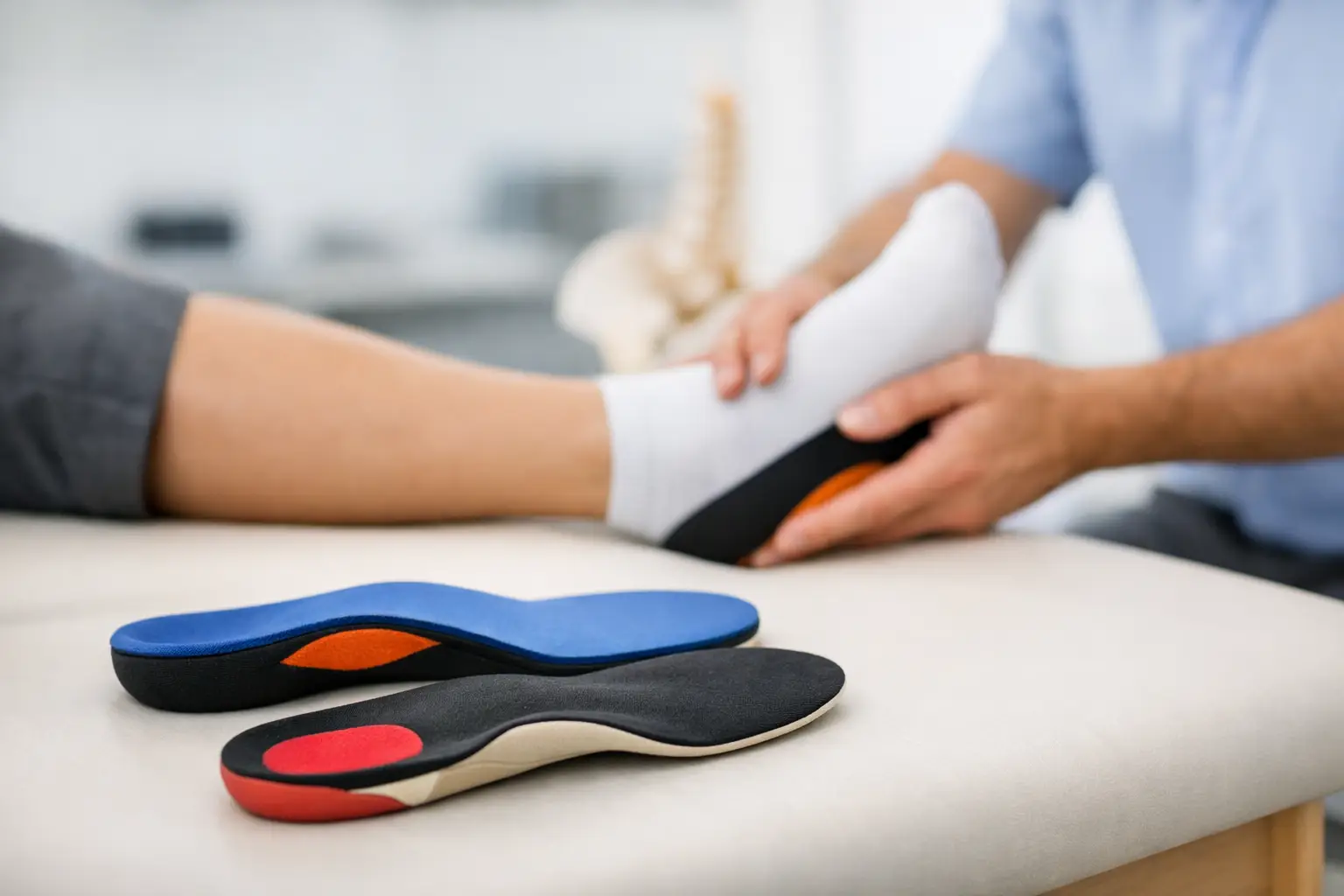
A good fitting process is structured and practical. You should understand what the orthotic is designed to do, which symptoms it is expected to help, and what it is unlikely to change. That level of clarity is important because it sets realistic expectations from the start.
You should also be advised how to wear them in gradually. Even a well-made orthotic changes the way load moves through the foot and leg, so some adaptation time is normal. Mild awareness in the arch or a sense that the foot is working differently can be expected early on. Sharp pain, rubbing or worsening symptoms that persist are not something to ignore.
Follow-up matters here. If the device is causing problems, is not fitting your shoes, or is not improving the intended symptoms, the plan may need adjusting. Orthotics are not a one-off retail purchase. They are part of a clinical pathway.
The role of footwear in any custom orthotics review
Orthotics and shoes work together. A well-designed device placed inside an unsupportive, excessively narrow or worn-out shoe may not perform as intended. This is particularly relevant for people switching between work shoes, trainers and formal footwear during the week.
The shoe needs enough depth, a stable base and a shape that suits your foot. In some cases, the best orthotic plan is limited by what your footwear will realistically accommodate. This is not a minor detail. It often explains why someone says an orthotic “did not work” when the problem was actually the shoe-device combination.
For active patients, footwear review is especially important. Running shoes vary considerably in stability, heel height, forefoot flexibility and fit. The right orthotic may feel completely different across two shoe models.
Are custom orthotics worth the cost?
That depends on what they are solving. If a custom device allows you to stay comfortable at work, return to training, reduce repeated flare-ups or avoid more invasive treatment, the value can be clear. If it has been prescribed without a proper diagnosis, the cost is much harder to justify.
Patients are right to ask what they are paying for. The value is not only in the physical device. It is in the clinical reasoning behind it, the way it is matched to your diagnosis, and the follow-up used to refine the result. Without that, a custom orthotic can become an expensive guess.
This is why a consultation-led model is often the safer route. At South London Foot Clinic, orthotics are considered within the wider assessment rather than offered as a default answer. If imaging is clinically indicated, it helps confirm which tissue is involved and whether load modification is likely to help. That creates a more accurate treatment plan from the outset.
Signs of a good orthotics recommendation
A sound recommendation is specific. It explains the diagnosis, the mechanical aim of the orthotic, how it fits with your rehabilitation, and what timeline is realistic. It also leaves room for the possibility that another treatment may be more appropriate.
Be cautious of anyone who recommends custom orthotics before examining you properly, or who treats pressure mapping and foot scanning as a diagnosis in themselves. Those tools can add information, but they do not replace clinical assessment.
A good clinician should also tell you when orthotics are optional rather than essential. Sometimes exercises, footwear changes, load management or an injection-led plan are more relevant. Reassurance and precision are far more useful than overselling.
If you are considering orthotics, the right question is not “Are custom orthotics good?” It is “What is causing my pain, and would an orthotic meaningfully change that?” Once that is answered properly, the decision becomes much clearer. A well-chosen orthotic can be very effective, but only when it follows careful diagnosis rather than guesswork.