


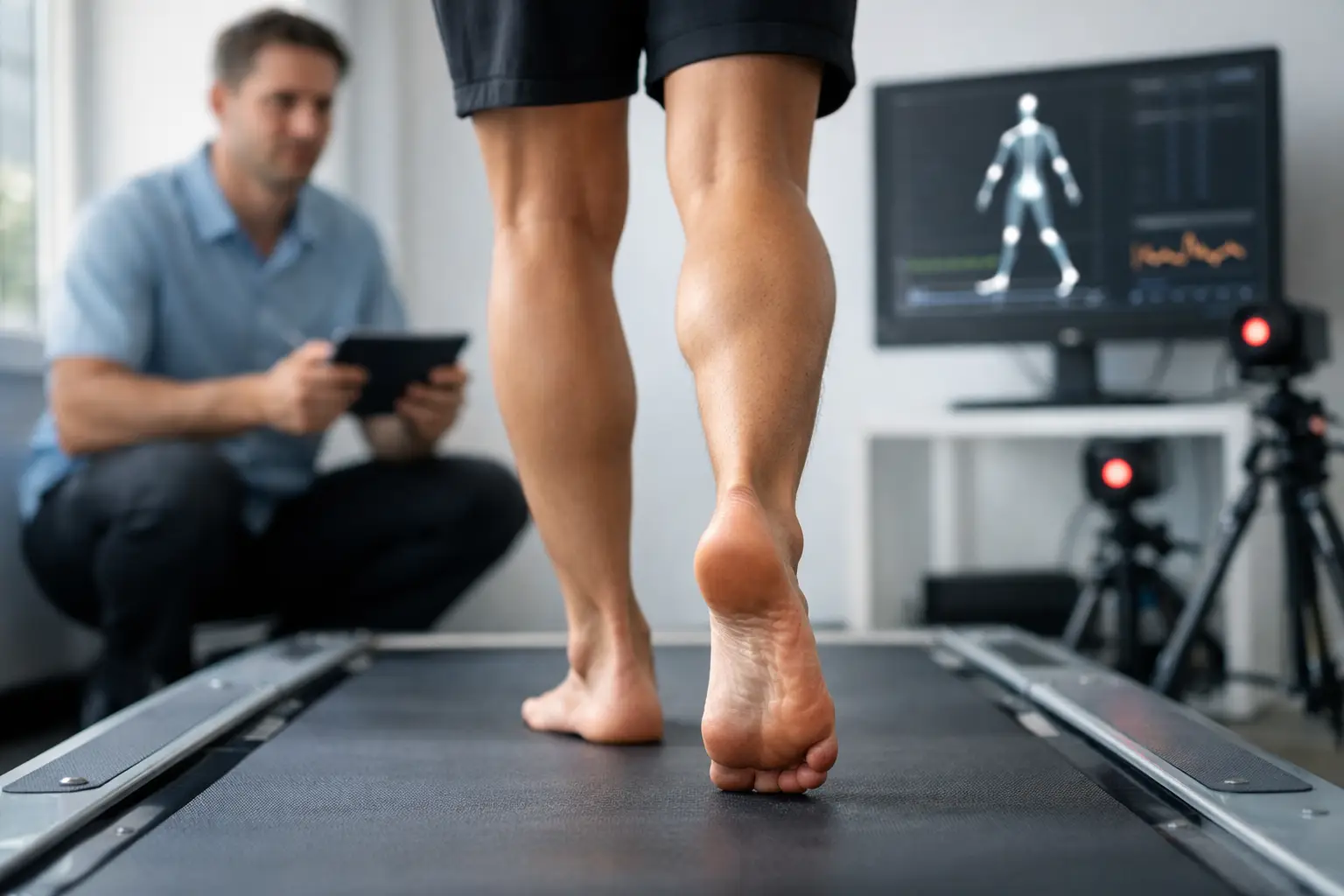
Gait Analysis for Foot, Ankle and Leg Pain
A person can have a painful heel, ankle or knee without being able to identify the movement that is keeping the problem active. Gait analysis looks at the way you walk or run to identify patterns that may be increasing load through a sore area. It is not simply about whether your feet roll inwards or outwards. A useful assessment considers how your feet, ankles, knees, hips and footwear work together, then relates those findings to your symptoms and activity.
For people with persistent lower-limb pain, this can provide practical answers. It helps distinguish between a movement pattern that is relevant to the problem and one that is simply a normal variation. That distinction matters before recommending orthotics, rehabilitation, changes to footwear or a return-to-running plan.
What gait analysis assesses
Gait is the sequence of movements involved in walking. During each step, the body accepts weight, moves over the foot and pushes away from the ground. Small differences in timing, joint movement, strength or control can alter where forces are concentrated.
A podiatry gait assessment starts with the clinical picture, not with a video clip in isolation. We would first establish where the pain is, how it began, what makes it worse and whether there has been a change in activity, footwear, work demands or training. Examination may then include joint range of motion, muscle strength, tissue tenderness, foot posture, balance and the way the affected area responds to loading.
Walking is observed from different angles, often at a normal pace and, where appropriate, at a faster pace or during running. The clinician may look at step length, foot placement, heel contact, ankle movement, knee position, pelvic control and how efficiently the foot progresses through each step. Footwear is also relevant. A worn or poorly matched shoe can affect comfort and stability, although it is rarely the only explanation for pain.
Why a walking pattern can contribute to pain
The body is designed to adapt to varied movement. A degree of asymmetry or inward foot motion is common and does not automatically require treatment. Problems are more likely when the demands placed on a tissue exceed its capacity to recover.
For example, reduced ankle movement can mean the foot or knee has to compensate during walking. Limited calf flexibility, weakness around the hip, a sudden increase in running distance or prolonged standing at work may all influence that pattern. If this occurs while the plantar fascia, Achilles tendon, forefoot or knee is already irritated, symptoms can persist despite rest alone.
This is why gait findings must be interpreted carefully. Someone may have a pronounced foot posture and no pain at all, while another person has only a subtle change in movement but develops symptoms after a rapid rise in training load. The aim is not to create a textbook walking style. It is to identify modifiable factors that are likely to reduce excessive strain and support recovery.
When gait analysis is useful
Gait analysis can be particularly helpful where pain is recurring, activity-related or not settling as expected. Common reasons for assessment include heel pain, plantar fasciitis, Achilles tendon pain, shin pain, forefoot pain, ankle instability and discomfort around the knee that appears related to walking or running.
Runners may benefit when symptoms emerge after increasing pace, mileage, hills or frequency. Equally, it can help people whose day involves long periods on their feet, those returning after injury and patients who feel that one side is consistently working harder than the other.
It is not needed for every foot problem. An ingrowing toenail, verruca or isolated skin condition does not usually require a gait assessment. Even with musculoskeletal pain, the priority may be to assess a specific injury first. If there is marked swelling, a sudden loss of function, severe pain after trauma, numbness or unexplained night pain, these features need appropriate clinical assessment rather than an assumption that walking mechanics are the cause.
Gait analysis is one part of diagnosis
A movement assessment is most valuable when it forms part of a structured diagnostic process. It can suggest why a painful area is repeatedly loaded, but it cannot on its own confirm the condition affecting a tendon, joint, ligament or fascia.
For this reason, the findings should be considered alongside your history and physical examination. Diagnostic ultrasound may be clinically indicated if there is uncertainty about the condition of a tendon, fascia, joint or soft tissue structure. Ultrasound can help assess features such as thickening, inflammation, tears or fluid changes, while gait assessment helps explain the loading environment in which that tissue is functioning.
This combined approach avoids two common mistakes: treating an image without considering the person’s movement and treating a movement pattern without establishing the source of pain. Not every scan finding causes symptoms, and not every visible gait variation needs correcting.
What treatment may follow an assessment
The right treatment depends on the diagnosis, the severity of symptoms and what you need your body to do. For some people, the principal intervention is a targeted rehabilitation plan to improve strength, mobility and load tolerance. This may include calf work, foot-strengthening exercises, balance training or a gradual return to walking and running.
Footwear advice may be useful if your current shoes are worn out, unsuitable for your activity or contributing to pressure and instability. However, changing shoes alone is not a universal solution. The most appropriate option depends on your foot shape, symptoms, activity and the support already provided by the shoe.
Custom orthotics may be considered when a measured change in foot support or load distribution is likely to help. Their purpose is not to force the foot into a fixed position. A well-designed orthotic can reduce stress on a painful structure, improve comfort and make rehabilitation more manageable. It should be prescribed against clear clinical findings and reviewed as symptoms and activity change.
Where inflammation or tissue pain is significant, other treatments may be discussed after diagnosis. These might include hands-on treatment, injection therapy or a period of modified activity. Such interventions have potential benefits and limitations, so they should be selected for the specific condition rather than used as a routine response to pain.
The value of reassessment
A gait pattern is not fixed. It can change with pain, fatigue, confidence, footwear, strength and training. Reassessment is therefore useful where treatment is not progressing as expected or when you are returning to higher-level sport.
The most meaningful outcome is not whether your walk looks different on video. It is whether pain is settling, confidence is returning and you can tolerate the activities that matter to you. A treatment plan should be adjusted according to those functional changes, rather than relying on one assessment finding.
Preparing for a gait assessment
Wear or bring the shoes you use most often for walking, work or sport. If running is part of the problem, bring your running trainers as well. Comfortable clothing that allows the knees and lower legs to be observed is helpful.
Before the appointment, consider when symptoms occur: at the start of activity, after a particular distance, the following morning or only in certain shoes. It is also useful to note recent changes in training, work, weight-bearing demands or injury history. These details often make the assessment more precise than a single observation of walking.
At South London Foot Clinic, gait assessment is used where it adds value to the diagnostic process, not as a standalone answer for every complaint. The focus is on explaining what is causing your symptoms, identifying the factors that can be changed and setting out a realistic treatment pathway.
If foot, ankle or leg pain is changing the way you move, an assessment can replace guesswork with a clearer plan. The next step is to establish the diagnosis, understand the load on the painful area and choose treatment that supports a confident return to daily activity.